The short answer
Constipation is one of the most common side effects of every GLP-1, shots and pills alike: 24% of adults on Wegovy had it in the trials, versus 11% on placebo. It is usually mild, but it lasts longer than nausea or diarrhea, so it needs a routine rather than a rescue: water, soluble fiber, a daily walk, then one osmotic such as magnesium or MiraLAX, with stimulants kept for short-term use. More than five days without a bowel movement, belly pain, vomiting or no gas is a same-day call.
At GLP-1 SOS constipation is the side effect people write to us about longest. Nausea tends to come and go in days; this one settles in. The GLP-1 Lab already answers the single questions, from magnesium citrate to MiraLAX. This guide puts them in order, from why it happens to the signs that it is no longer a home problem, with a link to the full answer at each step.
The short version
Constipation on a GLP-1 in three lines
1
Expected, and usually mild
Every GLP-1 label lists it. In the semaglutide trials, 98% of gut side effects were mild or moderate.
2
Slower to leave
A constipation episode lasted a median of 47 days on semaglutide, versus 8 for nausea. Plan a routine, not a rescue.
3
Climb the ladder in order
Water, soluble fiber and movement first; then one osmotic; stimulants short-term; prescription options with your prescriber.
Numbers from the Wegovy Prescribing Information (June 2026) and Wharton et al., 2022. Sources at the end of the guide.
Why GLP-1 medications constipate
Every GLP-1 label we checked, injection or tablet, states that the medication delays gastric emptying: food leaves the stomach more slowly. That is part of how the medication keeps you full. Researchers think slower movement further down the gut is what dries out the stool, although that part has been measured far less than the stomach. The result is the same either way: stool spends longer in the colon, the colon keeps pulling water out of it, and it comes out harder, smaller and less often.
Lab note
Less food, less water, a slower gut: three small changes that add up to one stubborn side effect.
The medication is only half of it. You are eating much less, so there is less bulk to move. Fiber falls with the food. And a good share of your daily water used to arrive inside meals, so fluid falls too, usually without you noticing. That is why the fixes below work on water, bulk and movement before anything else.
From the labels · weight-management doses
How common it is: shots and pills for weight
Wegovy: 24% vs 11%
On the 2.4 mg injection, versus placebo; 20% vs 8% on 7.2 mg. The label says the 25 mg Wegovy tablet’s side effects were similar in type and frequency.
Zepbound: 11 to 17% vs 5%
17%, 14% and 11% on 5, 10 and 15 mg. A higher dose did not mean more constipation.
Foundayo: 20 to 27% vs 9%
20%, 27% and 24% on the three daily doses of orforglipron, close to its nausea rates of 26 to 35%.
From the labels · type 2 diabetes doses
How common it is: diabetes medications
Ozempic: 3 to 5% vs 1.5%
5% on 0.5 mg and 3.1% on 1 mg in the placebo-controlled pool.
Mounjaro: 6 to 7% vs 1%
6%, 6% and 7% on 5, 10 and 15 mg; 13% in a large heart-outcomes trial of 6,647 adults.
Rybelsus: 5 to 6% vs 2%
6% on 7 mg and 5% on 14 mg of oral semaglutide.
Each label reports its own trials, people and doses, so compare doses within one medication rather than medications with each other.
Pills are not gentler on the bowel than shots: the Wegovy tablet tracks the injection, and Foundayo’s constipation rate sits close to its nausea rate. More in is the GLP-1 pill worse for nausea or constipation than the shot. Compounded semaglutide and tirzepatide have no FDA-approved label of their own; the active ingredients are the same, so these tables are the closest reference. For the plain answer to whether yours is the normal kind, read is it normal to be constipated on a GLP-1.
When it happens: the first weeks, each dose step, the long run
The first weeks. The Zepbound and Foundayo labels state that the delay in stomach emptying is largest after the first dose and eases over time. Appetite drops at the same moment, so food, fiber and fluid all fall at once.
Each dose step. The Wegovy label says its gut side effects were reported most often during dose escalation, and the pooled semaglutide trials found most people had their first gut side effect during or shortly after the escalation weeks. Constipation returning after a higher dose is the expected pattern. The Wegovy label also lets prescribers consider delaying the next step by 4 weeks when a dose is not tolerated.
The long run. Constipation behaves differently from the rest. In the semaglutide 2.4 mg trials, a typical nausea episode lasted 8 days and diarrhea 3, but constipation lasted a median of 47 days, against 35 days on placebo, and the share of people constipated rose until about week 10 and then held steady. The encouraging part: in the STEP 4 trial, among people who stayed on semaglutide, the share with constipation fell gradually over time. It gets better, slowly, which is why a steady routine beats waiting it out.
From the trials
The timeline in three numbers
47 days
median length of a constipation episode on semaglutide 2.4 mg, versus 35 on placebo and 8 days for nausea
Week 10
when the share of people constipated leveled off in the semaglutide trials, instead of fading like nausea
98%
of gut side effects on semaglutide 2.4 mg were mild or moderate in severity
Source: Wharton S, et al. Diabetes, Obesity and Metabolism, 2022 (pooled STEP 1 to 3 trials, and STEP 4).
The most common mistake we see is a bit of everything, one product at a time, a day or two each. Climb in order instead. Give each new rung two or three days before you judge it, and keep the rungs below it in place.
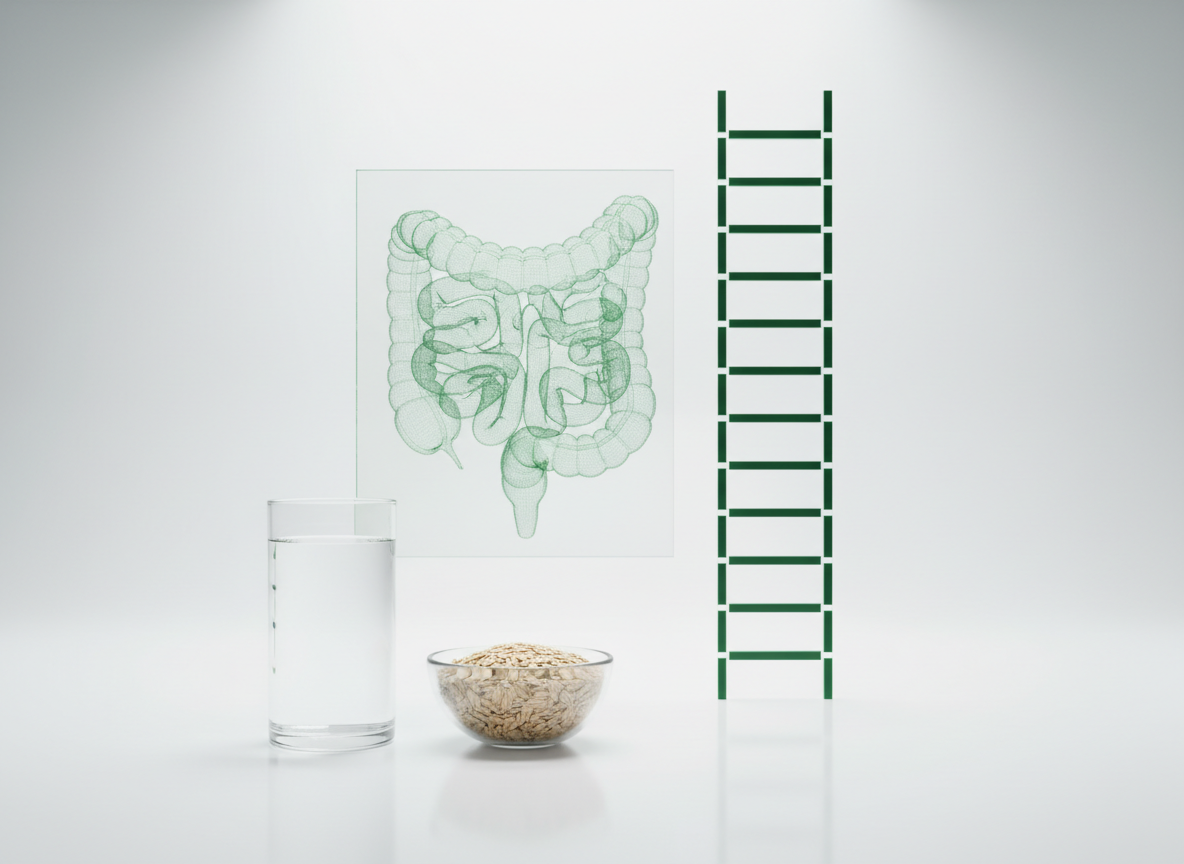
The ladder: what to do, in order
- Rung 1 · Water that stays, all day. Many people drink much less once appetite drops. Sip steadily between meals, and add broth, a pinch of salt or a sugar-free electrolyte mix on low-appetite days, since water follows salt. Targets are in how much water to drink on a GLP-1.
- Rung 2 · Soluble fiber, slowly. Oats, chia, psyllium and cooked vegetables form a gel that carries its own water. Add a few grams every few days, each with a full glass of water, and leave bran and raw salads for later. How much and which kind: how much fiber to eat on a GLP-1.
- Rung 3 · Movement and a toilet routine. A ten-minute walk after dinner wakes the colon better than most products. Sit for a few unhurried minutes after a meal, at the same time each day, with your feet on a small stool and no straining.
- Rung 4 · Magnesium, the right form. Magnesium citrate holds water in the stool; glycinate barely does; oxide works in the gut but less predictably. Take it in the evening with water, and count every source, multivitamin included, against the 350 mg a day the NIH sets as the upper limit for supplements. Read magnesium citrate for constipation on a GLP-1, magnesium glycinate vs citrate vs oxide and can I take magnesium with a GLP-1. Ask first if you have kidney disease.
- Rung 5 · One osmotic laxative, steady. Polyethylene glycol (MiraLAX) is not absorbed and has no listed interaction with any GLP-1. Its label says it generally works in 1 to 3 days and not to use it for more than 7 days unless a doctor tells you, so longer daily use is your prescriber’s call. Use magnesium or MiraLAX, not both, unless your prescriber says so. Details: can I take MiraLAX with a GLP-1.
- Rung 6 · A stimulant, only as short-term rescue. If two or three days pass with nothing on a steady osmotic, bisacodyl or senna at the package dose can restart things. The 2023 gastroenterology guideline supports bisacodyl for short-term or rescue use and gives senna a conditional recommendation. Regular use beyond the package limit is a prescriber decision.
- Rung 7 · Your prescriber’s options. If a steady plan has not worked in about a week, the same guideline strongly recommends prescription options such as linaclotide, plecanatide and prucalopride, tested in chronic constipation rather than in GLP-1 users. Your prescriber can also hold your dose longer. The full escalation plan is in what to do when nothing works for constipation on a GLP-1.
Honest options
If you want to buy one thing
From any pharmacy
- Magnesium citrate in the evening, lowest amount on the label, with a full glass of water
- Or MiraLAX at the label dose, within its 7-day limit unless your prescriber agrees to longer
- Plain psyllium, half a serving with a full glass of water, if your diet is low in fiber
One osmotic plus water and a walk covers the mechanism. It is what we tell people who ask us for the cheapest route.
What we make
- GLP-1 SOS Daily Gut Relief: 250 mg magnesium (citrate and oxide), 200 mg ginger root, 50 mg peppermint and a 19-strain probiotic blend with digestive enzymes, 2 capsules with dinner
- Built for rung 4 as a daily habit: it supports regular bowel movements and digestive comfort, with no fiber and no stimulant laxatives, so it sits alongside your fiber and does not replace a rescue
- It already contains magnesium and 9 mg of iron, so do not stack another magnesium product or an osmotic on top, and show the label to your prescriber if you take an iron tablet
60 capsules last 30 days. 60-day money-back guarantee on the first order. Made by GLP-1 SOS, the people behind this Lab.*
*GLP-1 SOS Daily Gut Relief supports regular bowel movements and digestive comfort. These statements have not been evaluated by the Food and Drug Administration. This product is not intended to diagnose, treat, cure or prevent any disease.
What not to do
Most stubborn cases we hear about at GLP-1 SOS are not missing a product. They are missing consistency, or one habit is quietly working against the rest.
Habits
What helps, and what backfires
Keep doing
- Small sips of water all day, with a little salt or broth when appetite is low
- Soluble fiber added a few grams at a time, each dose with a full glass of water
- One osmotic at the same small amount every evening
- A short walk after dinner, every day
- A simple log: dose day, bowel movements, what you took
Avoid
- Bran, raw salads or fiber gummies without extra water
- Two osmotics at once, or magnesium from three different bottles
- A big laxative dose after five days of nothing, then stopping everything
- Using a stimulant laxative daily beyond the package limit on your own
- Skipping or lowering your GLP-1 dose without your prescriber
Steady beats rescue. The swing from stuck to loose and back is usually overcorrection on a slow gut.
After days of nothing, liquid can slip around hard stool and arrive as sudden loose stool, which looks like a new problem and is not. If your days alternate, read constipation followed by diarrhea on a GLP-1 and why a GLP-1 causes diarrhea, and why it alternates with constipation. If the main complaint is a full, tight belly, is bloating normal on a GLP-1 covers what helps.
When constipation is a medical problem
All six labels we checked, Wegovy, Ozempic, Rybelsus, Zepbound, Mounjaro and Foundayo, list ileus, intestinal obstruction and severe constipation including fecal impaction among reactions reported after approval. Those reports are rare and voluntary, so the labels give no rate. The same labels warn about severe gut side effects in general: on Wegovy injection they were reported in 4.1% of adults versus 0.9% on placebo, and on Zepbound in 1.7% to 3.1% versus 1%. Each label also says the medication is not recommended for people with severe gastroparesis.
In practice: slow, hard and uncomfortable is the common kind. Nothing moving at all, with no gas, pain, vomiting or a hard, swollen belly, is not a laxative problem; it needs your prescriber or urgent care the same day. Severe, constant belly pain, especially spreading to the back, also needs a same-day call, because the labels warn about pancreatitis and gallbladder problems too.
Two kinds
Expected, or a same-day call
Usually expected
- A bowel movement every two or three days instead of daily
- Hard or small stools, some straining
- Worse in the first weeks and after each dose step
- Bloating that eases after you go
- Better within days of water, fiber or an osmotic
Call the same day
- More than five days without a bowel movement
- No stool and no gas, or a hard, swollen belly
- Vomiting, or not keeping liquids down
- Severe or constant belly pain
- Blood in the stool, black stool or a fever
Slow is normal. Stuck, swollen and in pain is not.
When to call your doctor
Call your prescriber the same day, or get urgent care, if:
- You go more than five days without a bowel movement
- You cannot pass stool or gas, or your belly stays hard and swollen
- You are vomiting or cannot keep liquids down
- You have severe or constant belly pain, with or without vomiting, or pain spreading to your back
- There is blood in your stool, your stool is black, or you have a fever
- You have watery leakage after days without a real bowel movement
- A steady plan has not helped after about a week
Slow is normal. Stuck with pain is not.

From the people behind the Lab
You do not have to figure this out alone.
GLP-1 SOS is the daily companion made for life on a GLP-1. Plain answers like this one, a support team that replies to real questions from real people, and daily formulas like GLP-1 SOS Daily Gut Relief, designed around the side effects that come with the medication. The GLP-1 Lab is our free education arm: no login, no paywall, no hype. Side effects are part of the road. Suffering through them is not.
Questions people also ask
Is constipation worse on Ozempic and Wegovy or on Mounjaro and Zepbound?
Neither clearly. On the weight-management doses, 24% of adults on Wegovy reported constipation versus 11% on placebo, and 11 to 17% on Zepbound versus 5%. On the diabetes doses it was 3 to 5% on Ozempic and 6 to 7% on Mounjaro. Each label reports different trials and people, so the honest comparison is within one medication, not across brands. The plan that helps is the same for all of them.
Does the Wegovy pill, Rybelsus or Foundayo cause constipation?
Yes, at rates similar to the shots. The Wegovy label says side effects of the 25 mg tablet were similar in type and frequency to the injection. On Rybelsus, 5 to 6% reported constipation versus 2% on placebo. On Foundayo it was 20 to 27% versus 9%, almost as common as nausea. Semaglutide pills are taken on an empty stomach with up to 4 ounces of water, so plan most of your water for later in the day.
How long does constipation last on a GLP-1?
Longer than the other gut side effects. In the semaglutide 2.4 mg trials, a constipation episode lasted a median of 47 days, versus 8 for nausea and 3 for diarrhea, and the share of people affected leveled off around week 10. Among people who stayed on treatment it then eased gradually. Expect it to return briefly after each dose increase, and build a daily routine rather than waiting it out.
What is the best laxative to take on a GLP-1?
There is no single best, but there is a best order. A steady daily osmotic, magnesium citrate or polyethylene glycol (MiraLAX), is the usual base, and the 2023 gastroenterology guideline strongly recommends polyethylene glycol. Stimulants such as bisacodyl or senna are for short-term rescue. Use one osmotic, not two, follow each package’s time limits, and ask your prescriber about prescription options if a week of a steady plan has not worked.
Should I skip or lower my GLP-1 dose if I am constipated?
Not on your own, but do ask. Constipation is often worst after a dose step, and the Wegovy label lets prescribers consider delaying the next increase by 4 weeks when a dose is not tolerated. Your prescriber may hold your current dose longer, add a prescription constipation medicine or check your other medications. If you have no stool and no gas, pain or vomiting, call the same day instead of waiting for your next dose.
Sources (10)
- Wegovy (semaglutide) injection and tablets, Prescribing Information. Novo Nordisk / FDA, revised June 2026.
- Ozempic (semaglutide) injection, Prescribing Information. Novo Nordisk, revised May 2026.
- Rybelsus and Ozempic (semaglutide) tablets, Prescribing Information. Novo Nordisk, revised January 2026.
- Zepbound (tirzepatide) injection, Prescribing Information. Eli Lilly, revised August 2026.
- Mounjaro (tirzepatide) injection, Prescribing Information. Eli Lilly, revised August 2026.
- Foundayo (orforglipron) tablets, Prescribing Information. Eli Lilly, revised July 2026.
- Wharton S, et al. Gastrointestinal tolerability of once-weekly semaglutide 2.4 mg in adults with overweight or obesity, and the relationship between gastrointestinal adverse events and weight loss. Diabetes, Obesity and Metabolism, 2022.
- Chang L, et al. American Gastroenterological Association-American College of Gastroenterology Clinical Practice Guideline: Pharmacological Management of Chronic Idiopathic Constipation. Gastroenterology, 2023.
- MiraLAX (polyethylene glycol 3350) powder for solution, Drug Facts label. Bayer HealthCare / DailyMed, U.S. National Library of Medicine.
- Magnesium: Fact Sheet for Health Professionals. NIH Office of Dietary Supplements.
Reviewed by the GLP-1 SOS editorial team · Education, not medical advice · Talk to your prescriber about your dose and your symptoms.