The short answer
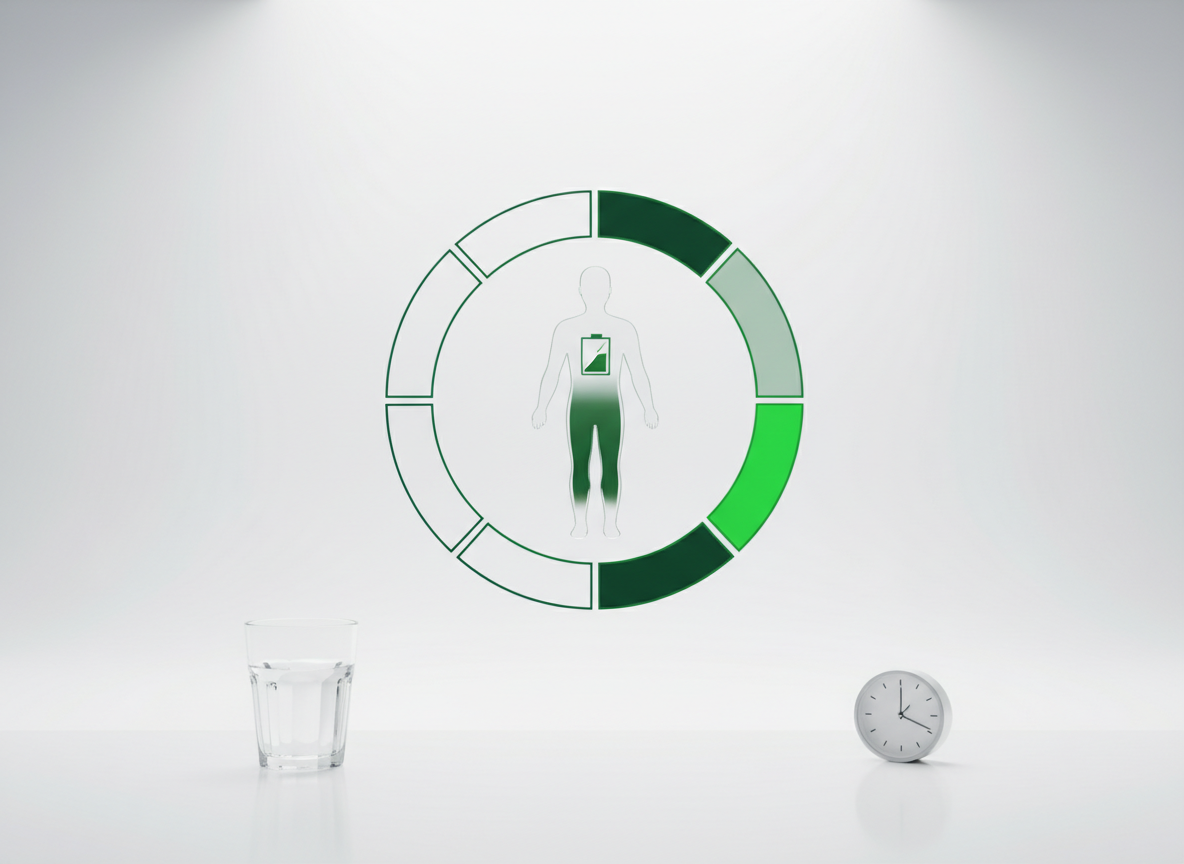
For most people, days to a few weeks at a time. The labels give no duration for fatigue, but its triggers run on a calendar: the first month, the first two or three weeks after each dose step, and the day or two after each shot, when the drug level peaks. Tiredness that lasts past two weeks on a steady dose, or arrives months in, needs a blood test.
At GLP-1 SOS the question usually comes with a date attached: I started six weeks ago, I went up a dose on Friday, I am four months in and suddenly exhausted. Those are three situations with three time frames, and one of them is not about the medication at all.
At a glance
Three time frames, one outlier
1
The shot days: 1 to 3 days
A dip the day or two after each weekly injection, when the level peaks. It lifts by midweek.
2
Each start or step: 2 to 4 weeks
The first weeks on a new dose are the heavy ones. Steady state arrives at about four weeks.
3
Months in: not expected
New tiredness at month three or later, on a steady dose, usually points to a slow nutrient drain. Test, do not wait.
Why the timing follows the dose
Fatigue is a listed reaction. The Wegovy label reports fatigue or weakness in 11 percent of adults on the 2.4 mg injection against 5 percent on placebo; the Zepbound label reports 5 to 7 percent against 3 percent. None of the labels give a duration, so the honest answer follows what drives it. The causes are covered in why a GLP-1 makes you tired; this page is about the calendar.
The shortest clock is the week. Semaglutide peaks one to three days after a shot, and tirzepatide a median of 24 hours after. That is when appetite and thirst are lowest, so it is when people eat and drink least. A flat day or two after the shot that lifts by midweek is the pattern we hear about most.
Lab note
Tired on shot days is the medicine. Tired every day for a month is a question.
The middle clock is the dose. The Zepbound label puts steady state at about four weeks, and the labels say gut reactions cluster during dose escalation and ease afterwards. Those reactions are what cut eating, drinking and sleep, which is why the first weeks of a new dose tend to be the tired ones. The Wegovy label lets your prescriber delay a step by four weeks if a dose is not tolerated.
The long clock breaks the pattern. Eating far less for months can run iron, B12 and other nutrients down, and that tiredness builds slowly instead of easing. Fatigue that starts at month three or later, on a dose you have been on for weeks, is new and worth checking. And when you stop, effects fade gradually: semaglutide stays in the blood about five to seven weeks after the last Wegovy dose, and tirzepatide has a half-life of about five to six days.
From the labels
The numbers behind the calendar
1 to 3 days
after a semaglutide shot, when the drug level peaks, per the Wegovy and Ozempic labels; about 1 day for tirzepatide, per the Zepbound label
4 weeks
to reach a steady level on a dose, per the Zepbound label, and the minimum time between dose steps on Wegovy and Zepbound
11% vs 5%
adults reporting fatigue or weakness on Wegovy 2.4 mg versus placebo, per the Wegovy label; 5 to 7% versus 3% on Zepbound
Sources: Wegovy Prescribing Information, June 2026; Ozempic Prescribing Information, May 2026; Zepbound Prescribing Information, August 2026.
What to do
- Date your tiredness. Note the day you started, your last dose step and your shot day. Most people can place their fatigue on one of the three clocks in a minute, and that tells you how long to give it.
- Plan small on the two days after the shot. Something every three to four hours, protein first, fluids sipped through the day. If the dip clears by midweek, it is the shot clock, and it usually softens as the weeks pass.
- Give a new dose four weeks before judging it. Count from the first higher shot. If weeks three and four are as flat as week one, ask your prescriber about staying longer on this dose; the labels allow for it.
- Keep one steady evening routine. A small, early dinner, the same each night, makes sleep and the next day easier. GLP-1 SOS Daily Gut Relief fits there: 2 capsules with dinner, with magnesium, ginger and peppermint for digestive comfort, plus B12, B6, iron and folate, which support normal energy metabolism when meals have shrunk. A basic multivitamin covers the vitamin part too.*
- If it lasts past two weeks on a steady dose, ask for bloods. Iron and ferritin, B12, folate and vitamin D, plus thyroid and blood sugar. MedlinePlus advises that fatigue not relieved by sleep, good food and less stress should be checked by a provider.
- Check your sleep, too. Nausea, reflux and night bathroom trips break sleep without you noticing. Sleeping nine hours and still waking tired? Read sleeping a lot on a GLP-1.
*GLP-1 SOS Daily Gut Relief supports regular bowel movements and digestive comfort. These statements have not been evaluated by the Food and Drug Administration. This product is not intended to diagnose, treat, cure or prevent any disease.
Two kinds
Settling-in tired, or worth a call
Usually expected
- Heavier the day or two after the shot
- Worst in the first weeks of a dose
- Lifts after a real meal, fluids and sleep
- Gone or nearly gone by the fourth shot
Call your prescriber
- No better after two weeks on a steady dose
- New tiredness months into a steady dose
- Fainting, or dizzy every time you stand
- Shaking and sweating, on insulin or a sulfonylurea
- Low mood that does not lift
Judge a dose on its fourth week, not its first.
When to call your doctor
Call your prescriber the same day if:
- You faint or nearly faint, or feel dizzy every time you stand
- Your heart races or pounds while you are resting, or you are short of breath
- You cannot keep liquids down, or you are passing very little urine
- You are confused, have blurred vision, or are unusually hard to wake
- You get shaking, sweating and sudden weakness and you take insulin or a sulfonylurea
- You have severe belly pain that does not go away, with or without vomiting
- If you have thoughts of harming yourself, call or text 988 (Suicide & Crisis Lifeline) now
Tired for a few days after the shot is common. Tired for weeks on a steady dose deserves a test, not patience.

From the people behind the Lab
You do not have to figure this out alone.
GLP-1 SOS is the daily companion made for life on a GLP-1. Plain answers like this one, a support team that replies to real questions from real people, and daily formulas like GLP-1 SOS Daily Gut Relief, designed around the side effects that come with the medication. The GLP-1 Lab is our free education arm: no login, no paywall, no hype. Side effects are part of the road. Suffering through them is not.
Questions people also ask
How long does fatigue last when you start Ozempic or Wegovy?
For most people the heaviest tiredness is in the first two or three weeks, easing as the dose settles over about four weeks. Semaglutide peaks one to three days after each shot, so those days stay the flattest for a while. The labels give no duration for fatigue. Still worn out after a month at the same dose? Ask for blood tests.
Does tiredness come back with every dose increase on Mounjaro or Zepbound?
Often, yes, in a milder form. Tirzepatide takes about four weeks to reach a steady level on a new dose, and the labels say gut reactions cluster during escalation. Those reactions cut eating and sleep, which is where most tiredness comes from. Give each step four shots before judging it, and ask your prescriber about staying longer on a dose if needed.
Why am I tired the day after my GLP-1 shot?
Because that is when the drug level is highest. Semaglutide peaks one to three days after a shot and tirzepatide about a day after, when appetite and thirst are lowest, so people eat and drink less. Small protein-first meals and steady sips help. Our page on whether it is normal to be so tired on a GLP-1 covers the common causes.
Is it normal to feel tired months into a GLP-1?
Not as a new symptom on a steady dose. Settling-in tiredness belongs to the first weeks and to dose steps. Fatigue that appears at month three or later is more often a slow drain from eating far less, such as low iron, ferritin or B12, or poor sleep. Ask your prescriber for blood tests rather than waiting it out. Our guide on how to fight fatigue on a GLP-1 has the daily habits.
How long after stopping a GLP-1 does the tiredness go away?
It depends on the cause. Semaglutide stays in the blood for about five to seven weeks after the last Wegovy dose, and tirzepatide has a half-life of about five to six days, so effects fade gradually. If tiredness came from low iron or B12, it lasts until those are corrected, whether or not you stop. Talk to your prescriber before stopping, and get tested if fatigue persists.
Sources (5)
- Wegovy (semaglutide) injection and tablets, Prescribing Information. Novo Nordisk / FDA, revised June 2026.
- Ozempic (semaglutide) injection, Prescribing Information. Novo Nordisk, revised May 2026.
- Zepbound (tirzepatide) injection, Prescribing Information. Eli Lilly, revised August 2026.
- Fatigue. MedlinePlus Medical Encyclopedia, National Library of Medicine.
- Iron-Deficiency Anemia. NIH National Heart, Lung, and Blood Institute (NHLBI).
Reviewed by the GLP-1 SOS editorial team · Education, not medical advice · Talk to your prescriber about your dose and your symptoms.